Not the risk you think
Understanding what can actually go wrong, and how risk management responds, is what separates serious analysis from headline-driven scepticism.

Understanding what can actually go wrong, and how risk management responds, is what separates serious analysis from headline-driven scepticism.
The primary risk in directional crypto investing is obvious: prices fall. In market-neutral investing that risk is largely removed by construction. What takes its place is less intuitive but, for allocators who engage with it seriously, more manageable.
Market-neutral strategies do not lose money because Bitcoin goes down. They lose money when the infrastructure those strategies depend on fails: an exchange collapsing and taking client assets with it, a stablecoin breaking its dollar peg, a smart contract being exploited or settlement systems seizing up during a dislocation. These are infrastructure risks, and they respond to entirely different forces than the macro events that drive directional losses. The distinction is not semantic. It determines how the risk gets managed.
Lessons learned
The crypto market has provided a live stress test of market-neutral resilience over the past several years.
The Terra/LUNA collapse in May 2022 wiped out tens of billions of dollars in combined LUNA and UST value within days. The FTX failure in November 2022 was the largest exchange insolvency in crypto history. The USDC depeg in March 2023 briefly threatened dollar-denominated settlement across the ecosystem. Each was severe for directional investors holding the affected assets.
Market-neutral strategies that had maintained off-exchange settlement, holding assets with an independent custodian rather than on the exchange's balance sheet, did not have assets on FTX's books. Their exposure was bounded by design. The Galaxy VisionTrack Market Neutral Index recorded peak-to-trough drawdowns of [-4.46%] and [-1.37%] through these periods, against directional losses measured in tens of percentage points over the same windows.
Four scenarios with precedent
A rigorous risk framework does not rely solely on history. It models specific scenarios forward and uses them to set position limits. The core stress scenarios for a market neutral portfolio include four principal events, drawn from the historical record.
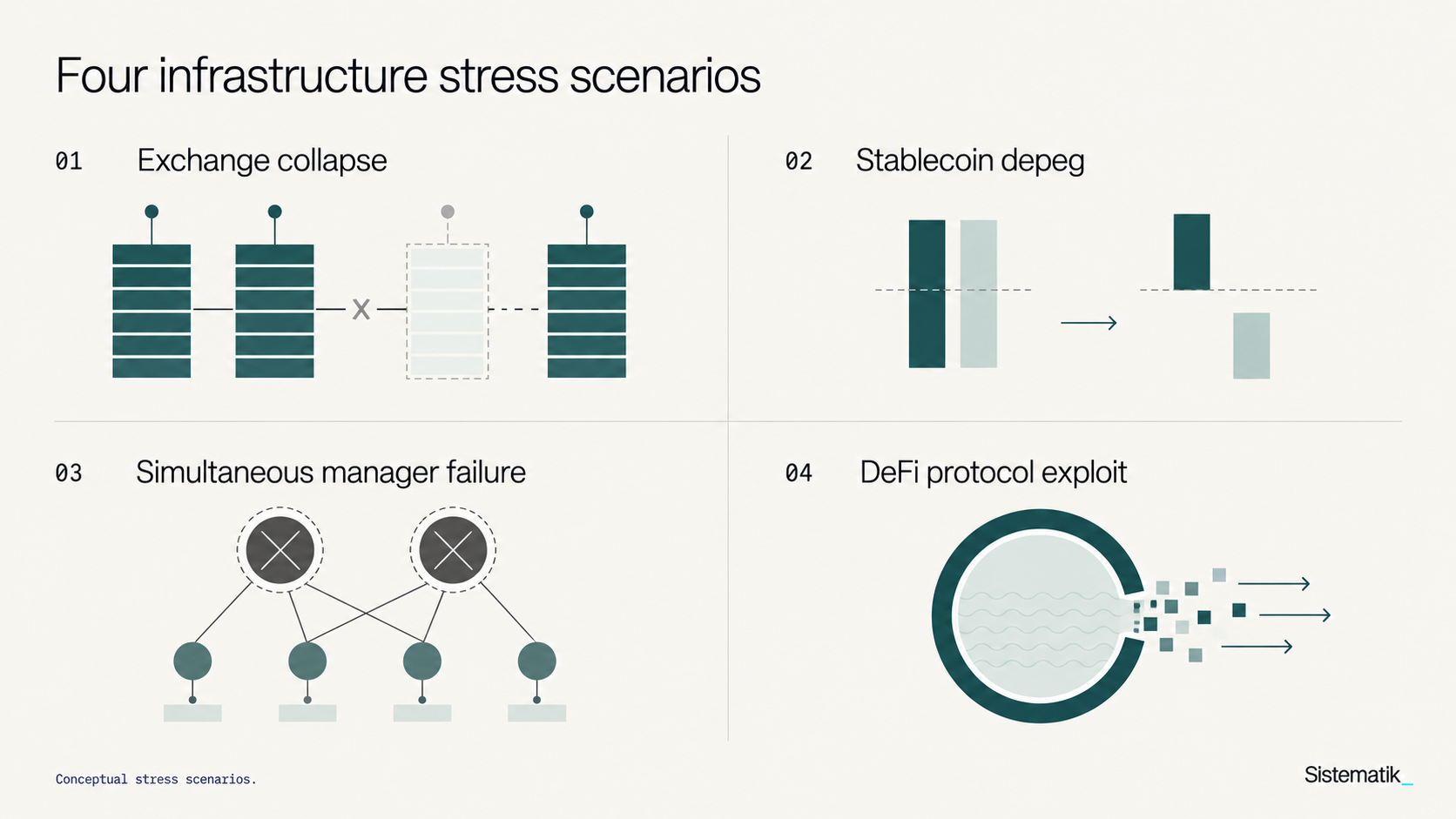
- A major exchange collapse: the immediate loss of all assets held on a primary exchange, combined with a collapse in funding rate income as traders close leveraged positions, and a wave of redemptions that forces strategies to sell into the same disruption.
- A major stablecoin depeg: a stablecoin losing a significant fraction of its dollar value, cascading through every position denominated in it.
- A simultaneous manager failure: the two largest allocations becoming illiquid at the same time through fraud or operational failure at the underlying manager.
- A major DeFi protocol exploit: a decentralised protocol losing funds, with secondary contagion to lending markets and stablecoins.
Each has a direct precedent within the last four years. A comprehensive framework models further scenarios, including correlated failures across several categories at once, but these four are the event types that have actually materialised.
Mitigations, and their limits
The response to each scenario is specific.
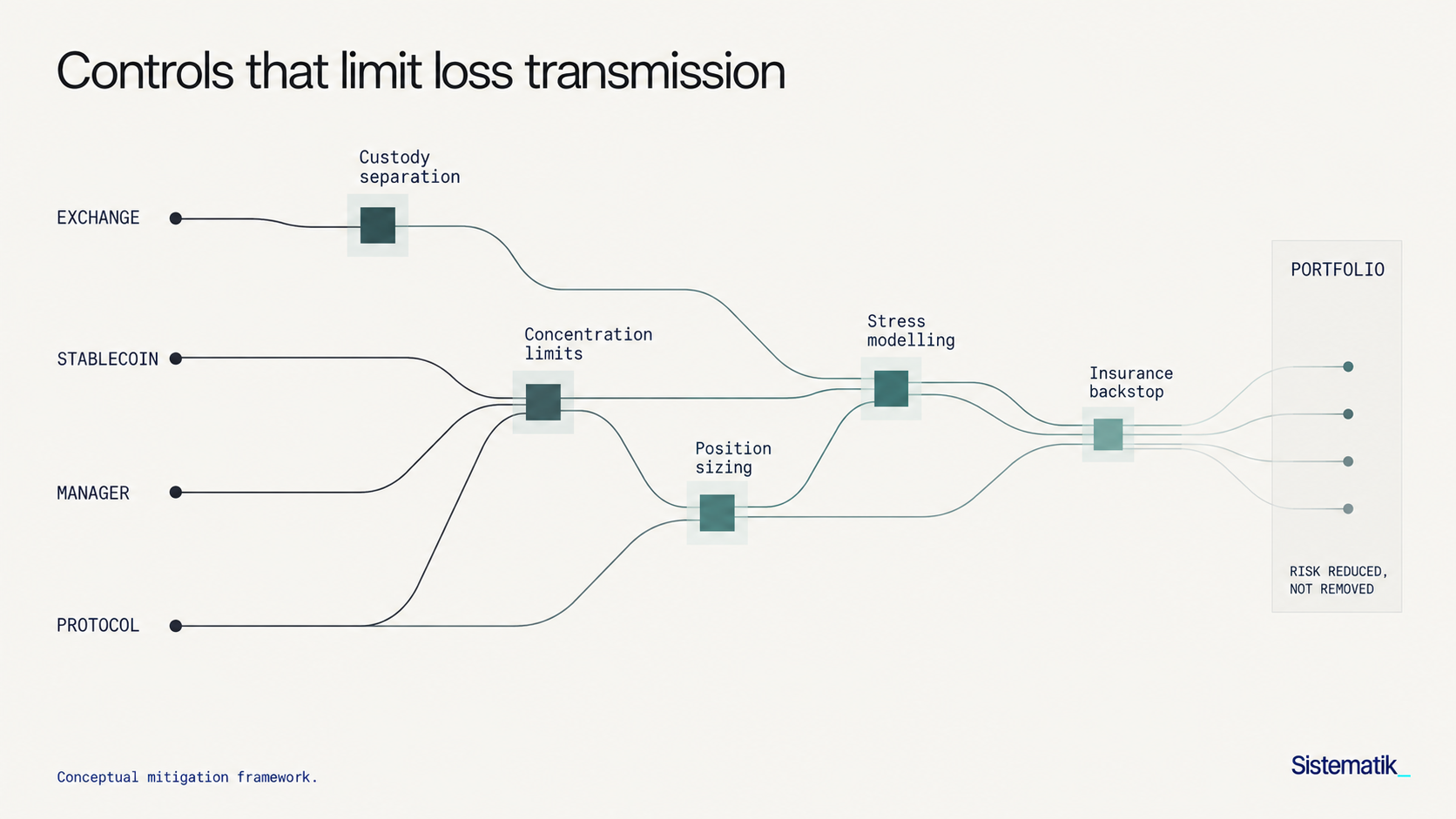
- Off-exchange settlement, where assets are held by a custodian sitting between the strategy and the exchange rather than on the exchange's own balance sheet, takes exchange insolvency out of the collateral pool. If the exchange fails, the assets are not part of its bankruptcy estate.
- Venue limits cap the portfolio's combined exposure to any single exchange across all underlying managers, so even where several managers use the same venue the aggregate risk stays bounded.
- Insurance carried by Exchanges and custodians protect against theft, employee fraud and certain cyber incidents. Some managers insure separately. A backstop rather than a primary control - the primary controls are where assets sit and how much can sit in any one place.
None of this removes the possibility of severe losses in an extreme scenario. A simultaneous collapse of a major stablecoin and a primary exchange would produce losses that no framework fully absorbs. The goal is calibration: ensuring that, across plausible stress scenarios, the expected portfolio outcome stays within institutional loss tolerances.
Stress modelling under extreme assumptions, with cross-manager correlations around 60%, typically places worst-case portfolio drawdown in the high single digits at the 99.9th percentile, against Bitcoin's historical worst case of ≈94%.
Compared to high yield credit
For allocators deciding where market-neutral crypto sits in a portfolio, the relevant comparison is not equities. It is the fixed-income-adjacent alternatives that occupy a similar expected return space: high yield credit, private credit and infrastructure debt.
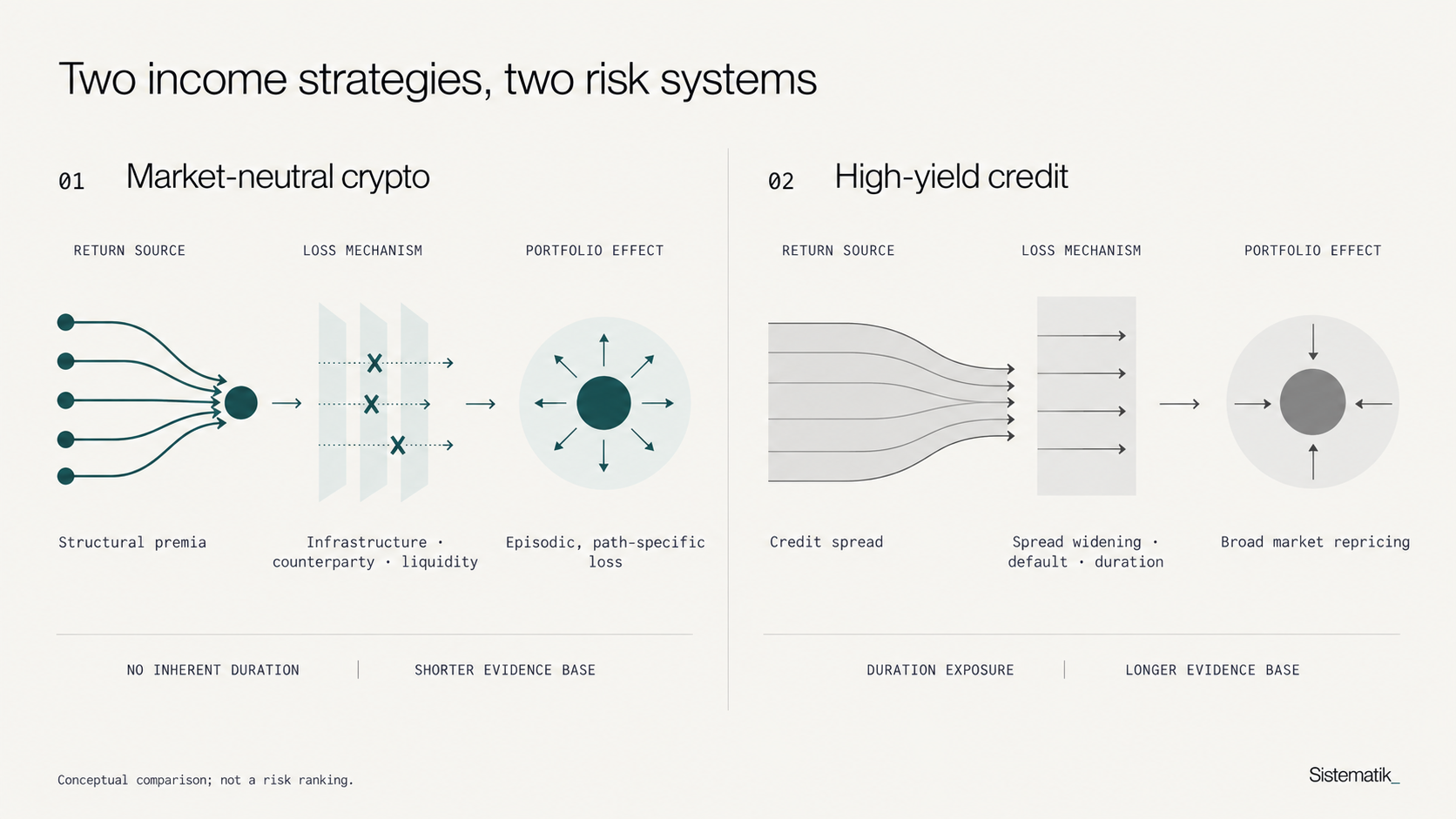
High yield credit earns the credit spread, the additional yield demanded for lending to sub-investment-grade issuers. Long-run default rates run at roughly 3-4% a year and senior unsecured recoveries average around 40%, producing expected net annual credit losses of 2-3%.
In severe credit stress, as in 2008 and 2020, high yield portfolios have drawn down 15-30%, driven mainly by spread widening rather than defaults. High yield also carries duration risk: when rates rise, bond prices fall regardless of credit quality, compounding spread losses with rate-driven price declines.
Market-neutral crypto's loss mechanism differs on both counts. The primary risk is infrastructure failure, not corporate default. The worst observed drawdown across the market-neutral benchmark universe has been roughly -4.6%, against -15% to -30% for high yield in comparable crisis windows. Duration risk is absent because there are no fixed payment streams to discount.
The return comparison has favoured market-neutral crypto in recent periods. Benchmark-level returns for the strategy class have run from high single to mid double digits net, against high yield yields in the mid to high single digits.
What six years of data show
Market-neutral crypto strategies have meaningful data going back roughly six to seven years, against four decades of modern high yield history. That period happened to include some of the most severe crypto dislocations ever observed: two major infrastructure failures, an exchange liquidity crisis, a partial stablecoin depeg and a prolonged bear market. Strategies that kept drawdowns limited through those events did so because they were positioned to earn from crypto markets rather than from their price direction.
That is a meaningful stress test, though not the same as the statistical confidence decades of credit data provide. Historical results should be read as indicative of structural potential, cross-checked against models under several correlation assumptions, not as a confirmed performance record.
Institutional deployment in practice
Two points matter for feasibility that rarely feature in strategy-level analysis.
The leading vehicles in this space now sit under regulatory frameworks appropriate for institutional capital, with documented governance, auditable risk processes and fund structures built for sophisticated allocators rather than the unregulated frontier product of an earlier era.
And unlike private credit or infrastructure debt with multi-year lock-ups, multi-manager market-neutral vehicles have generally been structured with redemption terms that fit institutional cash management. Neither point resolves the track record question, but both shape what deployment looks like in practice.
Where this leaves us
Market-neutral crypto strategies earn from structural features of digital asset markets: funding rate premia, pricing dislocations, volatility spreads, event dynamics. The primary risk is infrastructure failure, not price direction. A diversified portfolio of these strategies, built with formal position limits and stress-tested across several correlation regimes, has shown a risk-return profile that compares favourably with the fixed-income-adjacent alternatives allocators typically use as comparators.
For allocators who understand the difference between participating in crypto markets and being exposed to crypto prices, the asset class warrants evaluation on its own terms.
This article is for general information and educational purposes only. It describes general market mechanics and does not constitute investment advice, a personal recommendation, an offer, solicitation or invitation to buy, sell, subscribe for or dispose of any fund interest, security, token or other financial instrument. It does not refer to any specific fund product unless expressly stated and approved through the relevant process.

A monthly note on crypto market structure.
A monthly note on crypto market structure, market-neutral strategies and allocator-relevant risk topics. Written for allocators and professional market participants. One email a month.