Constructing a market-neutral portfolio
Not all market-neutral crypto strategies earn from the same source. That structural diversity is what makes the multi-manager approach work.
Not all market-neutral crypto strategies earn from the same source. That structural diversity is what makes the multi-manager approach work.
The argument for a diversified basket of market-neutral crypto strategies rests on one observation: each strategy earns from a different driver, and those drivers do not all move in the same direction at the same time. That separation is what makes the multi-manager approach a portfolio construction decision rather than a bet on any one technique.
The universe organises into seven strategy categories, each with a different return driver and a different failure mode.
The seven sources of return
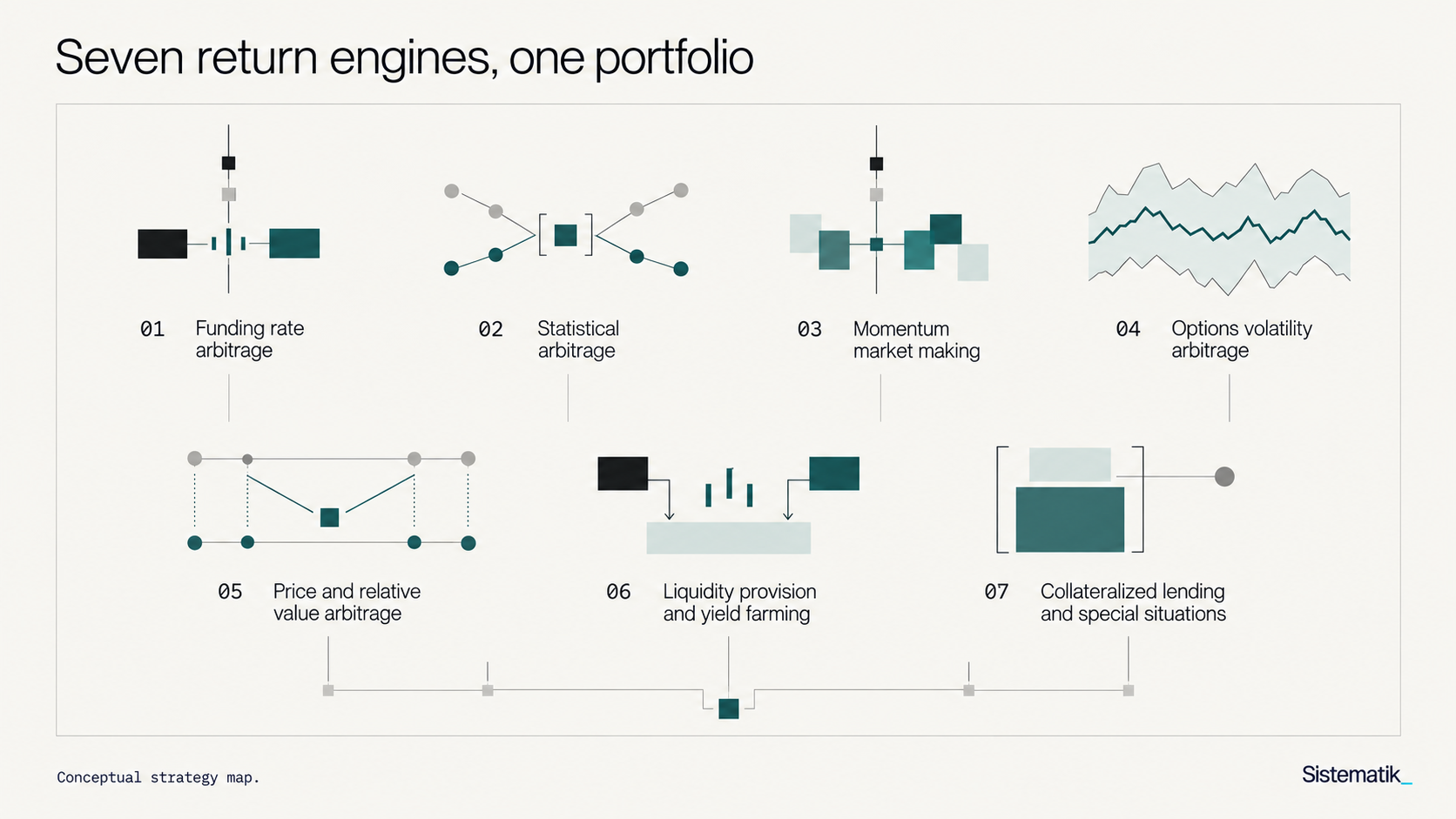
- Funding rate arbitrage is a strategy that holds an asset and an equivalent short position in perpetual futures. The two positions cancel each other's price exposure. What remains is the funding rate - a periodic payment that leveraged long traders make to the short holders to keep their positions open. Returns depend on the level and persistence of those rates, which reflect how much leveraged speculation is in the market. Rates rise in bull markets and compress in quieter periods, but have historically been positive on average.
- Statistical arbitrage, momentum and market making exploit pricing inefficiencies across venues. When two assets that normally move together temporarily diverge, the strategy profits as the relationship converges back to that relationship. Market makers extend this by quoting on both sides of the order book and earning the bid-ask spread. The return comes from the persistence of pricing dislocations and the volume of trading activity.
- Options volatility arbitrage captures the spread between implied and realised volatility. Implied volatility, the market's forecast of future price moves embedded in option prices, has consistently exceeded realised volatility in crypto. The strategy sells options at elevated implied volatility and hedges the directional exposure, earning the gap between what the market expected and what actually occurred.
- Price and relative value arbitrage operates where the same asset trades at different prices across exchanges, blockchains or instrument types. Bitcoin quoted at two prices on two venues at the same moment is the simplest version. The strategy buys the cheaper one and sells the more expensive one simultaneously. Returns depend on pricing differences across fragmented markets, a structural feature of crypto that has persisted through multiple market phases.
- Liquidity provision and yield farming target the incentives that decentralised finance protocols pay to attract capital. Strategies systematically capture these returns, including fees, token incentives and lending rates, while hedging the directional exposure that comes with holding the underlying assets. How much they earn varies with the incentives protocols offer as they compete for liquidity.
- Collateralised lending generates yield by lending assets to borrowers who post collateral worth more than the loan. If the collateral falls below a set threshold it is automatically sold to repay the loan. Returns depend on the interest rate borrowers are willing to pay, which reflects demand for leveraged crypto exposure.
- Special situations arise around token launches, blockchain upgrades, exchange listings and protocol changes. These events create predictable supply and demand imbalances around a specific trigger, and returns come from event-specific dynamics that are largely independent of market direction.
Different drivers, different timing
These seven categories earn from different sources, and that matters for portfolio construction because they do not all suffer at the same time.
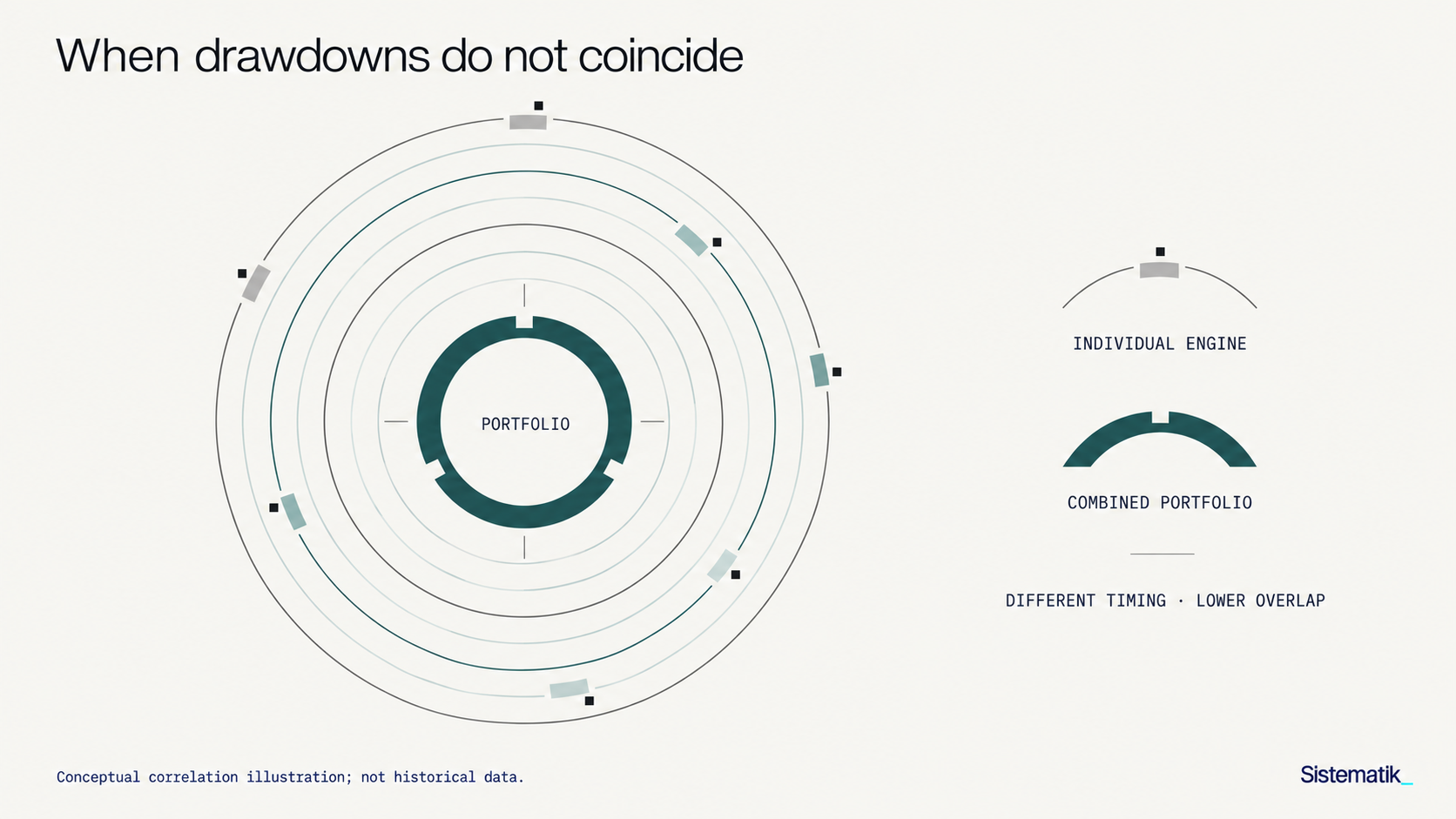
Funding rate arbitrage earns less in low activity markets, but low activity markets produce pricing dislocations that statistical arbitrage profits from. When markets are quiet, implied volatility tends to exceed realised volatility by wider margins, improving volatility arb returns. Special situations are idiosyncratic by construction. The forces driving each strategy are different enough that a downturn in one does not automatically pressure the others. The forces driving each strategy are different enough that a downturn in one does not automatically pressure the others.
Harry Markowitz formalised the mathematics of this in the early 1950s: when return streams are imperfectly correlated, combining them reduces portfolio volatility without proportionally reducing expected return. A portfolio of managers whose individual volatilities range from low single digits to well above 20% can, at appropriate weights, produce aggregate volatility well below the average component, provided the correlations are genuinely low.
The mechanism shows up in practice in one specific way: drawdowns at individual managers tend to occur at different times. So the portfolio's worst month is shallower than the average of its components' worst months during market stress events where directional strategies suffered significantly.
Roles, tiers and limits
Building a diversified multi-strategy portfolio requires explicit structural decisions that enforce diversification even when market conditions create pressure toward concentration.
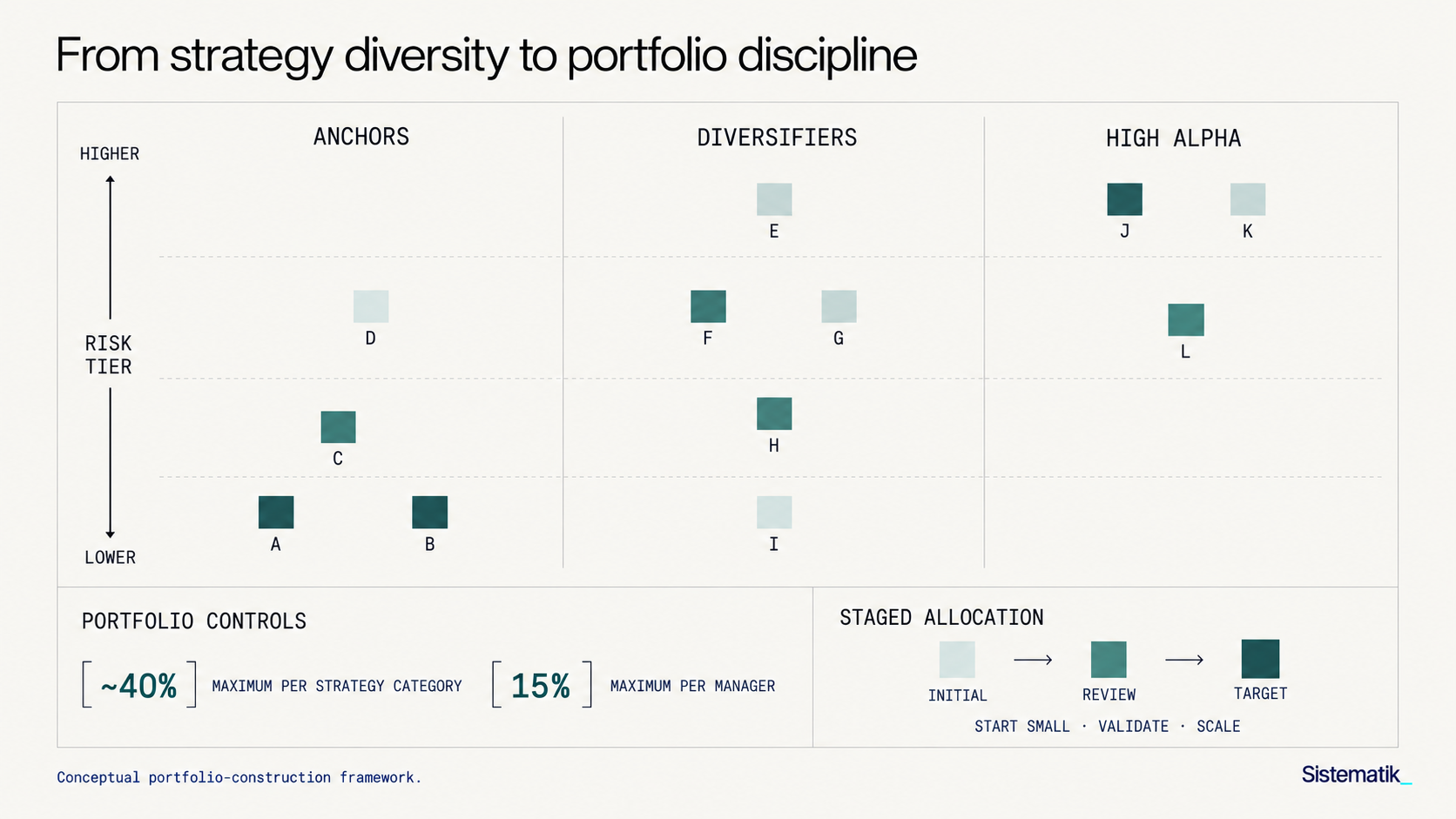
A structured approach assigns each manager two classifications: a portfolio role and a risk tier.
- Anchor strategies - typically lower-volatility approaches like funding rate arbitrage - provide stable return streams across market environments.
- Diversifier strategies contribute different return drivers that reduce portfolio-level drawdown in specific scenarios.
- High alpha strategies accept greater volatility in exchange for higher expected returns, sized so they contribute without dominating aggregate risk.
Strict position limits enforce the discipline. Capping any single strategy category at around 40% of the portfolio prevents concentration in one return driver. Capping any single manager at 15% of net asset value ensures no individual position can determine portfolio outcomes. These limits matter most when a strategy is performing well, precisely when the temptation to concentrate is highest.
Managers typically start at a fraction of their eventual target weight, which gives time to assess operational robustness and reporting quality before committing full capital.
What happens under stress
The correlation benefit is not constant, and this matters. During acute stress events, the Terra/LUNA collapse and the FTX failure being the clearest examples, correlations across strategies rose sharply. Shared infrastructure dependencies (common exchanges, stablecoins, settlement chains) mean that even structurally uncorrelated return drivers can draw down together when the infrastructure itself fails. Strategies lose not because Bitcoin went down but because operational and settlement infrastructure broke down across venues at once.
A rigorous risk framework models this explicitly through three correlation regimes: normal market conditions, stress and extreme contagion. Each produces materially different loss estimates, and the stress and extreme scenarios are inputs to position sizing and limit setting.
This article is for general information and educational purposes only. It describes general market mechanics and does not constitute investment advice, a personal recommendation, an offer, solicitation or invitation to buy, sell, subscribe for or dispose of any fund interest, security, token or other financial instrument. It does not refer to any specific fund product unless expressly stated and approved through the relevant process.


A monthly note on crypto market structure.
A monthly note on crypto market structure, market-neutral strategies and allocator-relevant risk topics. Written for allocators and professional market participants. One email a month.